Who are you?
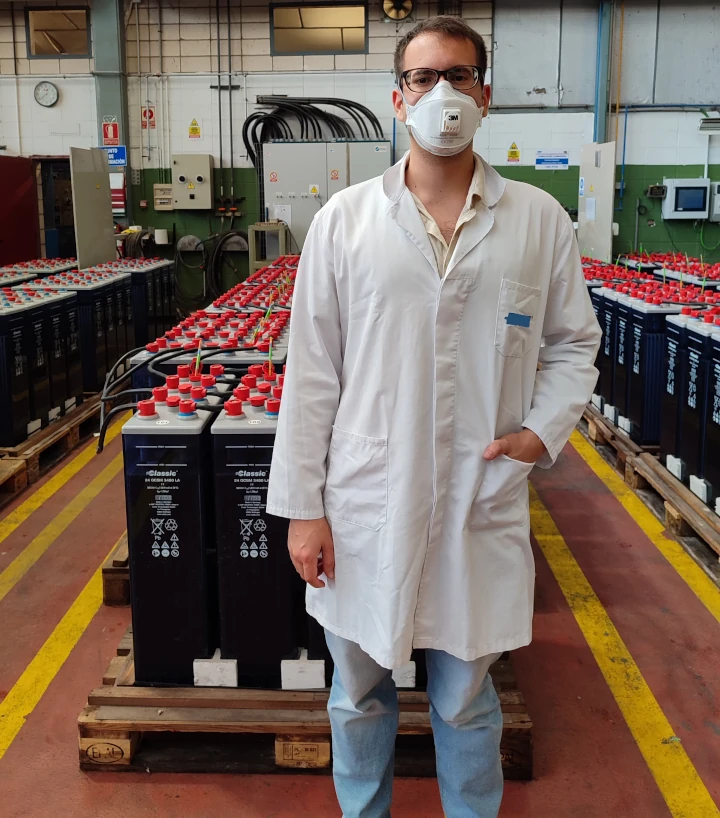
I am Alberto Trujillo, founder and CEO of Fusgement. I am a certified professional project manager (PMP) and also an electrical engineer from Universidad Carlos III de Madrid.
How did you choose the profession?
I remember that ten years ago I decided to study engineering. I come from a humble family: my father is an electrician and my mother is a teacher. They have always worked hard, even running side businesses. At school they told us that without a degree we were nobody because in Ávila, which is small, there is not much professional future, and many young people leave because there are very few good jobs.
I did not want to depend on my parents forever. I wanted to support myself. I had to leave my hometown to study in another city, in Madrid. Studying engineering was the decision I made then, because I had heard there were development opportunities in that sector. I saw solar plants, power stations, new technologies, and I wanted to know how they worked. I admired the number of things they could power. Energy can accelerate and amplify the things we want to do.
Do you consider yourself good at what you do?
I don't like to say that I am very good just like that. What I can say is that I made decisions not to limit myself. I decided to study engineering in English because I wanted to compete at the same level as anyone, inside or outside Spain. I didn't want language to be another stone in the road.
Electrical engineering and the profession itself have high failure rates. It is not easy to finish on time. It was hard, demanding. Many people do not finish it despite planning to. I did finish it, also thanks to the support of my classmates. We worked hard as a team and made good friendships that I still have today.
How did you start working?
First I joined a company that made air conditioners and heat recovery systems. They wanted to improve the product, and I learned automation, control and how the company operated. Later I worked with a friend on protection and control. It was a demanding stage, with real responsibility.
After that I was contacted to manage projects for substation cells, while the factory was being relocated. I replaced a project manager and continued what had been left behind. There I learned how to align interests and how to get things done. Later I worked in a company with a good product but management gaps, where I led teams of engineers on large projects, including complex projects over 1 million euros and up to 20 stakeholders, so I understood how much organisation influences technical results.
What do you feel now, some time after finishing your degree?
Having finished the degree well and now being free is a very beautiful thing. It was hard and, to be honest, the compensation was not as good as one might expect. One would hope the effort would be rewarded. But I have certainly learned many things and I hope to drive my business forward.
What about pressure from assignments you don't want to do?
I have always had pressure from tasks that may not have been the best, and I have spent a few years trying to take better care of myself and not accept certain jobs that do not fit what is important to me. Now I have more opportunities to do things the way I would like. To be independent and value what I really want to value.
Is it too hard a profession?
The profession is hard and demanding, that is no doubt. But as I said, in my case it was the best way I thought of years ago to live independently and to be valued for my work. I have given up some things and persevered to become a professional engineer.
I think there is room for improvement in the system. Electrical engineering is complex, but many times what makes it more difficult is not the technical part, but how the work is organised and how the professional is valued. As a sector we must work so that what we do is better understood and that we are valued fairly.
Do you think you are responsible when equipment built at a company where you worked fails?
Engineering is a collective responsibility. I am accountable for what is under my control and I have always worked with rigor. I have never compromised that criterion. Electricity is very dangerous. It is true that in large projects faults can occur. They are complex systems with many people and decisions involved. I have a clear conscience about my work.
There is still a lack of qualified professionals and that affects the quality of results. When there is not enough prepared staff or management is not adequate, risks increase. That is why I believe the system can and must improve. There is a shortage of trained people, and that goes hand in hand with making the business more economically attractive so that things are done better. When the system does not incentivise professionalisation and good management, results suffer and cracks appear. It is a structural problem, not an individual one.
Why do you want to carry out your company?
When I decided to create my company it was not only for personal independence. It was because I see things that can repeat themselves and that happen throughout the industry. In several companies where I worked, the greatest challenge was not technical but managerial, in coordination, lack of structure and how decisions are made.
There I understood something important: in large, complex electrical projects, the difference is not only knowing engineering, but knowing how to organise it. My experience in protection and control, substations and project management allows me to have a transversal view of the complete system, from technical detail to financial and operational impact.
What I am building now, I want it to focus on something perhaps unknown in many places: a PMO, a Project Management Office, not only engineering things. The PMO is a way to coordinate projects with technical discipline and clarity in management.
Regarding the engineering side, the energy market is going to grow. Electrification is being driven at all political levels to reduce external dependence. But that growth also increases complexity and risk. And when complexity increases, execution becomes the real differential. I believe there is a good opportunity there.
Not competing on price, but on reliability, technical judgment and the ability to optimise and coordinate teams in demanding environments. My objective is to build a structure that can grow while maintaining that technical judgment and execution discipline. My advantage is not just knowing electricity; I have seen how systems fail and have decided to build a better system and a way of doing things that is more sustainable.
How do you see the energy landscape in Spain and Europe?
This has been true for some time: the electrical system is not new, what may be new are some technologies and how they integrate. But the system itself is not new. The main challenge is the coordination of the actors involved: regulation, investment, operators, industry and consumers.
Electrification is structural and will continue, but the increase in complexity also increases the risk if it is not managed well. I wonder whether execution will keep pace with growth. That is where I see the greatest challenges. The electrical grid is becoming more distributed, more digital and more demanding. That requires more professionalisation.
What differences do you see since you started?
Since I started I notice a big difference. Now there are many tools and many Artificial Intelligences, which can greatly improve the amount of work and add more value to each engineer who uses them, but it must be valued that there is a person behind the decisions.
AI is a powerful tool, but someone must use it with judgment. If the professional behind the decisions is not valued enough, in the long term it can bring problems and fewer people will want to dedicate themselves to engineering, increasing the deficit of qualified professionals even more. If it is used without judgment, it can generate more problems than solutions. Properly used, AI can raise the sector's level and multiply the capacity of a technical team without reducing its responsibility.
Does this activity have a future, do you think it will end?
No, it will not end because there are more people and more money, so no, it is not going to end. But growth does not mean everything will automatically work well. There are clear inefficiencies in the market and in project execution. That is where real opportunities exist for those who know how to organise engineering and management better. Energy demand, industrial transition and electrification of transport mean the sector has long-term prospects if we invest in the future.
How does your activity impact Spain?
Project management and electrical engineering impact the country's stability and development directly when done well. I alone do not change the system, but I can influence how the projects I participate in are executed, how the team is coordinated and the technical standard that is demanded.
What do you think about electricity consumption and production?
If there were no consumption there would be no production, although it is true that consumption is bigger every day and there is a lot of global electricity demand. That requires planning and prepared professionals. It is not just about generating more energy, but doing it safely, stably and sustainably. The balance between production, grid and demand is increasingly delicate and requires good management.
Do you have dreams?
I really want my company to survive over time. Personally, I would like to have my own comfortable house that is ecological and energy self-sufficient, with a garden for lettuce and fruit. I also want time and resources to dance and enjoy life with others, to be accepted and even admired by a community with a shared vision.
I also want one day to have a stable, formal partner. And to continue building something that makes sense to me. For me, personal and professional life are not so separate; I want what I build to be coherent with the life I want to live.